June 29, 2011

Beyond Paisley, as part of SDA

Sample of scarves:

Close up of stitching from bottom left corner

Beyond Paisley and Peacocks: Handcrafted Textiles of India and its Neighbors is a show now on view at Goldstein Museum of Design on the St. Paul Campus of the University of Minnesota - included as one of the many fibre art exhibits across the Twin Cities for the Surface Design Association's Confluence conference.

Artisans in South Asia use hand techniques for exquisite apparel and home use. After four centuries, Americans still import textiles from India, Pakistan and Bangladesh. This exhibition connects American fashion to textiles produced for local markets. The show is curated by Hazel Lutz and Anna Carlson, from Donald Clay Johnson’s Paritosh Collection of South Asian Textiles.


Two Scarves

Close up of stitching lines


Shawl

Stitching detail showing colourways


Sari, cotton, made in Gujarat, India - unlike western tradition, this wedding garcholu would be worn throughout a woman's married life for special occasions...


Kantha stitch on bed coverings (two separate quilts shown)


Stole, of silk, made in Gujarat, India - this accessory shows the influence of Japanese shibori with the emphasis on texture. Most of the texture imparted by the tie-and-dye process has been left in the cloth rather than ironed out...


Original paisley pattern...


Ari hooked needle embroidery. Ari is a form of chain stitch embroidery made with a hooked needle which is pushed through the cloth catching the thread below. This type of embroidery was imported to France where it acquire the name 'tambour' for the embroidery hoop's resemblance to a drum.


Shawls, made in Punjab, Pakistan - made for local use, these two phulkari or 'flower worked' cloths are embroidered from the back using a counted-thread technique. Silk threads on cotton...


Dupatta, of cotton, made in Gujarat, India - this exemplifies the finest quality work by the nearly mechanical regularity of the tie-and-dye dots, woven gold accents, and careful dipping that create the large blocks of color. It balances minute detail with boldness in the design.

June 27, 2011

Morgan Clifford at SDA

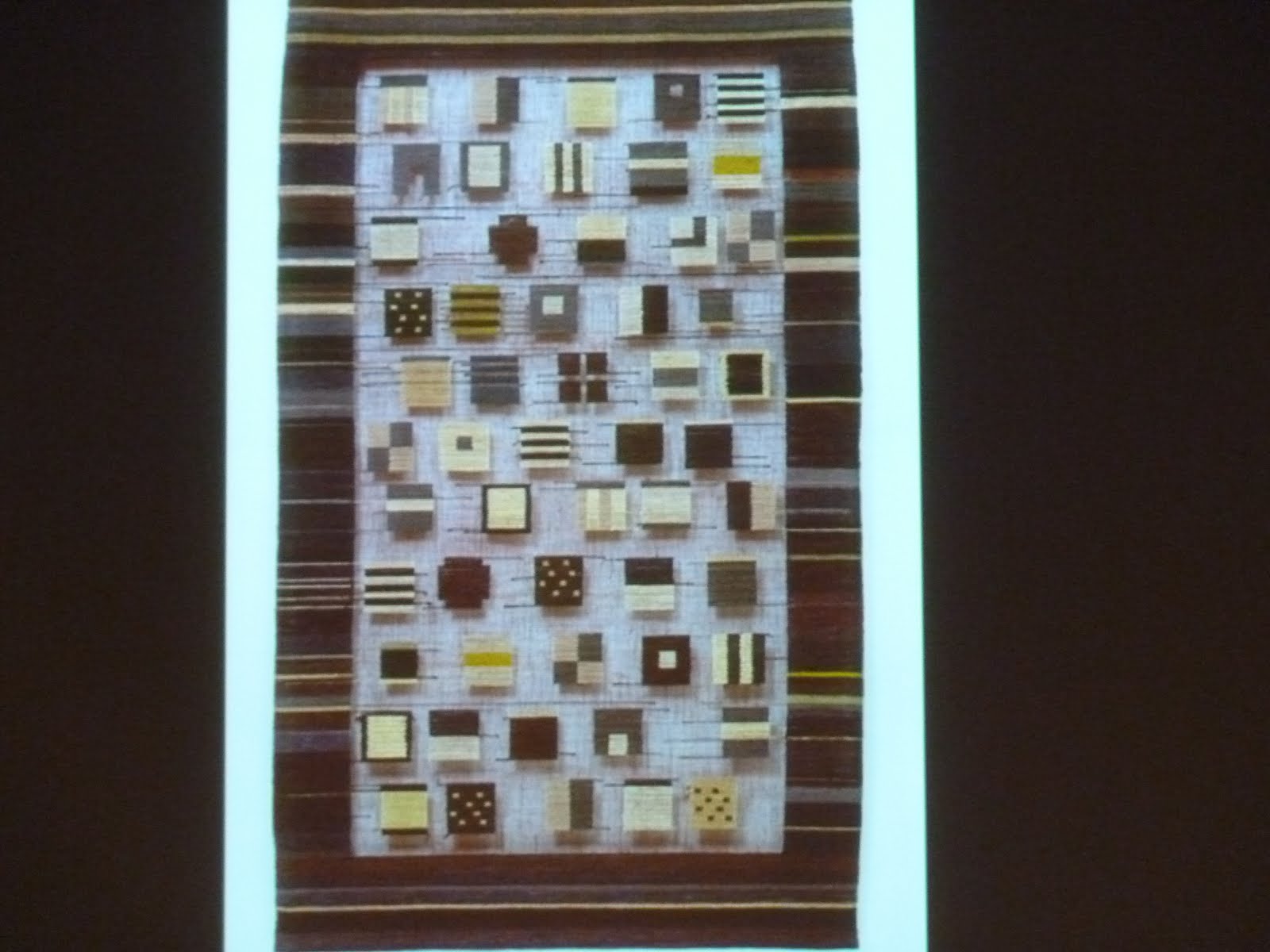
Morgan Clifford's Checks, Nets and Woven Grids exhibition was at the Traffic Zone Center for Visual Arts, an artist cooperative located in the historic Warehouse District of downtown Minneapolis, Minnesota as part of the Surface Design Association's sponsored exhibitions at its Confluence conference 2011.


Morgan is a weaver who uses gauze-weave structures as the nets in which small, colourful, geometric shapes and pattern float across the surface. She uses unusual fibres in her weavings such as those from the Japanese store Habu in New York City.

A week later I got to attend a lecture by her discussing her career as a weaver and as head of the Fibers Program in the Art Department at the University of Wisconsin-River Falls.

As she says, "what do you do with leftover headshots from publications?" Put them together as a starter slide in presentations!


June 25, 2011

Just returned from a month of textiles!

I travelled to Minneapolis for the Surface Design Association conference which takes place every two years. (I was a SDA conference virgin but can see why people go year after year!) After years of being hosted in Kansas City, it is now changing its location every two years travelling the country looking for another home.

Minneapolis was a great start as I had no idea what a textile centre it was!!! There were over 33 textile exhibitions on in the city while we were there, and even though our first day was a choice of 4 different bus tours (how many can you cram in?) we didn't see near as many as we would have like to.

I started at the Minnesota Center for Book Arts and the show by Jiyoung Chung entitled Whisper-Romance using the traditional Korean method of paper-making called "Joomchi". I LOVED IT!! Since I started my artistic life in paper before moving onto fabric, and always wanted to incorporate the paper and text into my work, I loved what she was doing with this ancient art form.

Joomchi is a unique Korean traditional way of making textured handmade paper by using water and Hanji (Korean mulberry papers). Record says that the Koreans started making Joomchi in Chosun Dynasty, 1392 - 1910. Joomchi creates strong, textural and painterly surfaces by layering and agitating. Its usages are diverse and it can be incorporated into surface design, collage, 2D and 3D, and functional objects such as lamps, space dividers, purses, garments.

Here is some of her work:

    And loving the exhibit so much, I was thrilled to attend a demonstration by Jiyoung Chung to see how she makes the paper. People who signed up for her actual class commented on cramping forearms and carpal tunnel syndrome, as the technique is very labour intensive and a very physical activity. Sure made me appreciate what she does even more!


June 05, 2011

Playing with a new type of art...

I have been experimenting with a new working format for pieces in the upcoming Saskatchewan exhibition based upon our study session in southern Saskatchewan back in 2008. The working title for the show is Dreaming Patterns: Stitching Memories and everyone will be making pieces the same 12" x 24" size.

My new technique is a mixed media collage with a lot of machine and hand stitching on a stiff background. The entire piece is then painted white and layered, layered, layered with transparent acrylics to come up with a colour scheme. Machine and hand stitching is added on top with various other embellishments (could be beading, tags, collage.)

These were my experimental pieces about 8" x 18" which I was selling at the previous Calyx show.

Called Serenity, this one has paper beads, french knots filling burlap squares, and 
seed stitch acting as a filling stitch.


This one is called Peace and has gilding, lace, tags, and brads.


June 02, 2011

Calgary's PechaKucha #8

Devised in Tokyo in 2003, PechaKucha Nights are now taking place in over 380 cities around the world. Drawing their name from the Japanese term for the sound of "chit chat," PechaKucha Nights are based on a simple presentation format: speakers present 20 slides each, for only 20 seconds per slide. It's a format that makes presentations concise and keeps things moving at a rapid pace.

Held on Monday the 27th, I got a phone call from a friend who had just found out it was to be held that very evening. I had just returned home from a weekend away and we were out at our cabin that day on flood watch but decided to take it in. The theme of this PechaKucha Night was INSPIRE.

It was held at downtown, at the Grand Theatre, a lovely renovated theatre that is about to celebrate its 100th anniversary. The invited speakers were:
  • Dean Bareham, Co-Artistic Director, Green Fools Physical Theatre
  • Suzanne Boss, Project Manager, applying for Cultural Capital of Canada 2012
  • Ken Cameron, Playwright/Persuasive Presentation Specialist
  • Aviv Fried, Owner/Baker, Sidewalk Citizen Bakery
  • Ken Greenberg, Architect/Urban Designer, former Director of Urban Design and Architecture for the City of Toronto
  • Kristina Groves, Four-Time Olympic Medalist, Speed Skating
  • Kevin Kent, President/Chief Knife Nerd, Knifewear Inc.
  • Tony Luppino, Executive Director, Leighton Art Centre
  • Dan Meades, Director, Vibrant Communities Calgary, people living in poverty in Calgary
  • Lara Presber, Fashion Designer inspired by architecture

It was another wonderful evening and so entertaining! Kevin Kent, the knife nerd was definitely the best presenter with his references to punk musical history tying into Japanese knives. Olympian Kristina Groves also knew how to captivate an audience with her tale of running the Olympic Torch relay. Always a great night out!!

June 01, 2011

Related Posts Plugin for WordPress, Blogger...